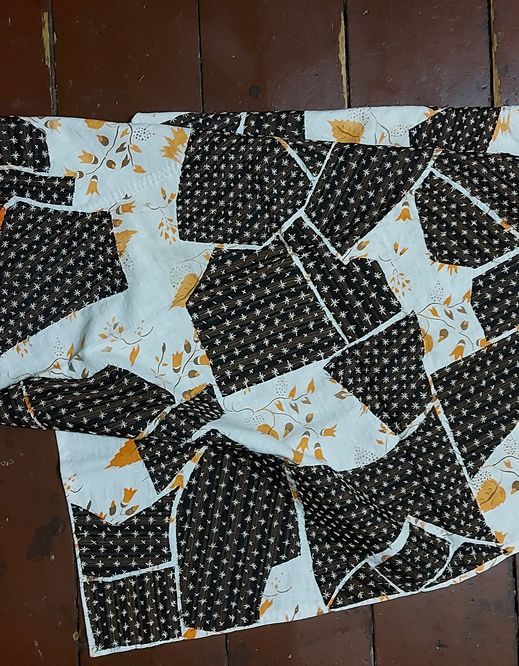
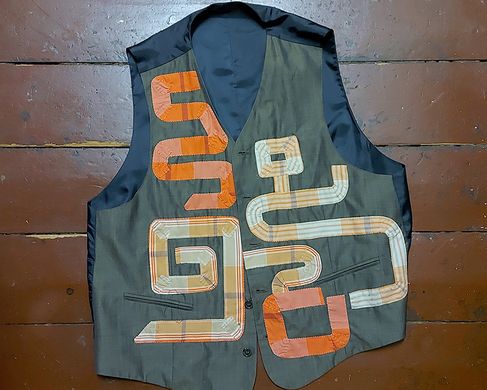
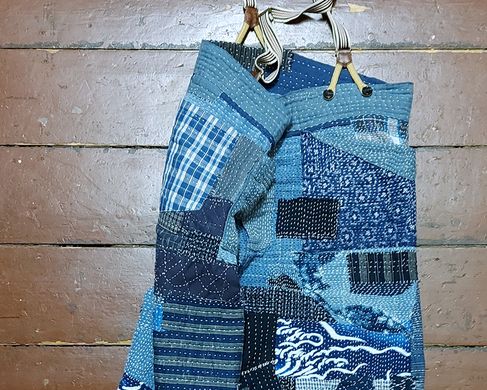
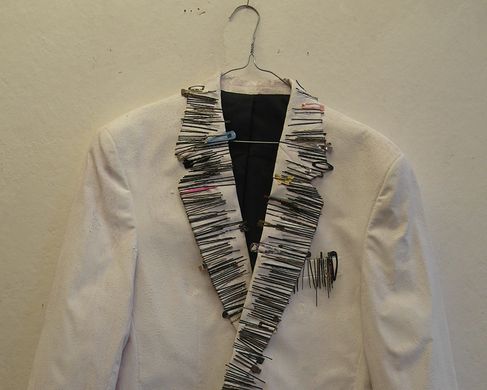
Textile techniques are one of the earliest cultural achievements of humankind, and to this day, fabrics are our second skin. The Industrial Revolution took the manufacturing of textile goods from of our hands. This, however, has led to “fast fashion,” a harmful trend for us and our environment. Today, we understand the close connection between thinking and manual work. Sewing and repairing may be simple activities, but they open up a playing field in which we can reclaim our creativity and hands-on skills.
The workshop will focus on traditional Japanese hand sewing techniques, such as sashiko, which is about recognizing the artistic potential of textile materials and developing possible ways to realize it. Participants will also learn various sewing techniques so they can bring their own ideas to life and become familiar with possibilities for refining their artistic expression in their work with textiles.
key data
- Venue
- Festung Hohensalzburg
- Date
- 20. 7. – 1. 8. 26
- Teaching language
- English (German and Japanese possible)
- Participation fee
- 670 Euro (reduced 495 Euro)
- Requirements
- Skills in hand sewing come in handy. Patience, enjoyment of details work and lengthy working processes.
- What to bring
- Laptop, camera/mobile phone, paper, medium soft black pencil, coloured pencils, sharp-ener, ruler longer than 25 cm, a range of textiles (garments and fabrics) from cotton, linen etc. if possible used and with traces of use; glass head pins, needles in a range of sizes, different threads (thicker and thinner ones) in contrasting colors, good scissors for fabric, paper scissors, measuring tape, thimble.
- Maximum number of participants
- 20
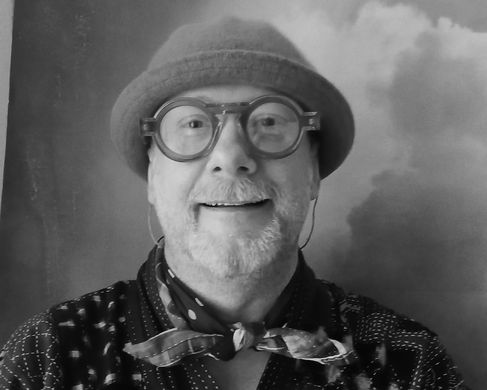
Walter Bruno Brix
Walter Bruno Brix was born in Southern Germany. Throughout his life, a strong affinity with Japan has brought him many intensive encounters and amazing opportunities. While still apprenticed in a trade, he began producing art-works in which Japanese skills and traditions play a major role. After studying the language, he spent some time in Japan in order to make an intensive study of the local textile traditions. He spent several further periods there, to immerse himself in the art of paper-making and familiarise himself with the tradition of Buddhist textiles. Back in Europe, he used his knowledge for academic research into collections of Japanese – and later, Chinese and Korean – textiles. He produced catalogues, curated exhibitions in museums and shared his knowledge in seminars and workshops, drawing on his wide practical experience, which is enhanced by collaboration with artists and artisans such as Carter Smith, Hiroe Ogawa and Helmut Kunkel, and by his work for a Kunstverein in Cologne. In both his artistic and his academic work, handicraft remains his source of inspiration.
Exhibitions
2024 Second Life – Upcycling Kunst und Kunsthandwerk, Kreismuseum Zons (DE).
2021 Editz und Rosa Stein – Leben zwischen Judentum und Christenheit, Kirche Christi Auferstehung, Cologne (DE).
2020 Mit Stich und Faden, Museum August Macke, Bonn (DE).
2017 Die Sprachen des Textilen, Museum Villa Rot, Burgrieden (DE).
2014 Wanderlust Poste Restante, Atelier 301, Frankfurt (DE).
Unclean Project, SomoS, Berlin.
Kunstroute Ehrenfeld, als Gast im Atelier Boehm/Dohmen, Cologne.
2013 Gestickt eingefädelt, Galerie Hinterland, Vienna.
Trügerisch, Frauenherzen, mit Peer Boehm, Museum für verwandte Kunst, Cologne.
Poste Restante, tadlachance, Cuges (FR).
Zedernduft und Frühlingsnebel, Kimonoausstellung, Tenri, Cologne.
Eleonore Prochaska, Stadtarchiv Danneberg (DE).
Alter Angle, SomoS, Berlin.
Privat, 68elf e.V., Cologne.
Spuren und Schatten, Museum für Asiatische Kunst, Berlin.
2012 Das seh ich anders – Dank dir, 68elf e.V., Cologne.
Finale, Kunstraum 22, Cologne.
It’s raining men, Ausstellungsraum Jürgen Bahr, Cologne.
2011 Mein Liebling, 68elf e.V., Cologne.
Ist es am Rhein so schön?, 68elf e.V., Cologne.
Fadenspiel, Kunstraum pro arte, Hallein (AT).
Der andere Blick, 68elf e.V, Cologne.
Reliquien aus dem Paradies, Stadtmuseum Neuötting (DE).
2010 Mapping the Body, Ausstellungsraum Jürgen Bahr, Cologne.
Heimat, Kunstraum sixteen, Zug (CH).
Publications
2023 Thousand Stitches – Thousand Paths: kesa – Buddhist robes in the Japanese tradition. Interpreted and realised by Rosmarie Gabathuler, Sistranz/Munich. https://www.agenturauguste.de/project/tausend-stiche-1000-pfade/
2020 Dragons made of golden threads – Chinese textiles from the collection of the German Textile Museum. https://www.na-verlag.de/programm/a/af/afw/drachen-aus-goldenen-faeden-2/
2018 The origin of patterns – A collection of rare proto-templates from Japan, Zons/Munich. https://okumi.wordpress.com/publikationen-books/vom-ursprung-der-muster/
2014 Kesa – Patchwork for enlightenment, Basel/Munich. https://okumi.wordpress.com/publikationen-books/kesa-flickwerk-zur-erleuchtung/