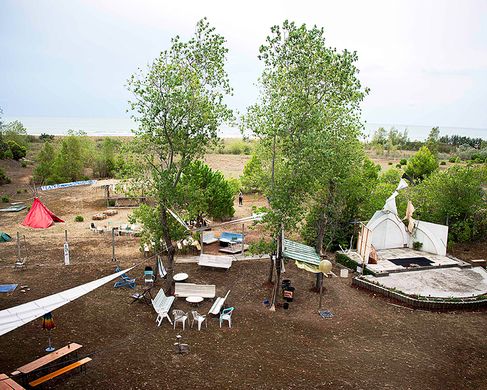
Fading Grounds / Grounding Commoning
Fading is not simply what disappears: it is a condition of transition, a moment in which forms, roles, boundaries, and meanings lose definition. In this sense, rather than mourning disappearance, Fading Ground frames it as the common ground from which new forms of coexistence and communing can emerge.
Fading acts as a device—spatial, material, and relational; uncertainty becomes a condition to be investigated rather than resolved. Fading is not intended in a nostalgic sense—as something that is being lost—but as a generative condition.
The workshop invites participants to act collectively in public space and to sense the spaces where certainty dissolves and relations emerge, grounding commoning through situated practices and shared actions.
Through temporary spatial interventions, participants will engage with different contexts, materials, and public programmes to inhabit what is fragile and ephemeral.
Attention will be given to practices of attunement and care: individual explorations and collective experiments intertwine, supported by moments of dialogue and reflection. The three-week workshop opens a common ground where design becomes a relational act and space a continuous negotiation.
key data
- Venue
- Festung Hohensalzburg
- Date
- 10. – 29. 8. 26
- Teaching language
- English (Italian possible)
- Participation fee
- 890 Euro (reduced 635 Euro)
- Requirements
- Willingness to work collectively and in small groups.
- What to bring
- Analogue and digital tools you are used to work with. Please bring basic camping gear for the possibility of an immersive outdoor experience: tent, sleeping bag, sleeping mat, weather-appropriate clothing, rubber boots and sturdy shoes, headlamp or flashlight, work gloves, backpack, personal toiletries, and a water bottle.
- Maximum number of participants
- 20
Biennale Urbana
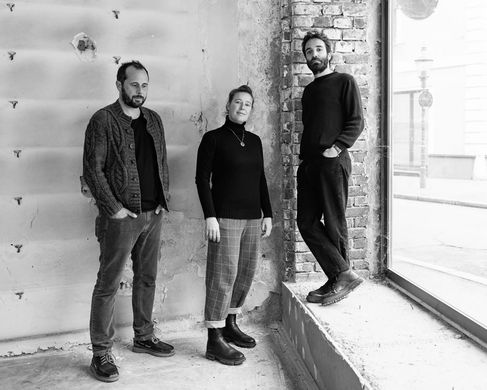
Giulia Mazzorin, Andrea Curtoni / Biennale Urbana (BUrb), Italian collective based in Venice working at the intersection of architecture, art, and urban research. Since 2022 are directors of the Department of space&designstrategies at the Kunstuniversität Linz. Their practice focuses on urban interventions, participatory processes, and the reactivation of marginal and transitional spaces through creative and critical strategies. They explore how materiality, social dynamics, urban environments intertwine, crafting research-driven and experimental approaches that invite reflection, imagination, and new ways of inhabiting the city.
Website
Exhibitions
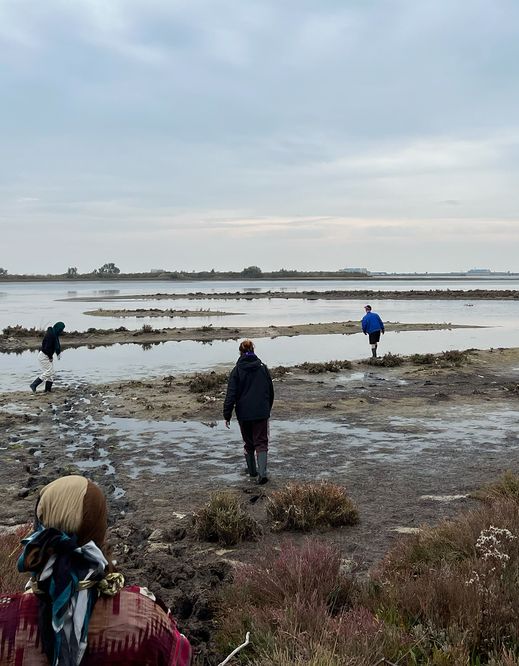
2025 A Tidal Walk across Sant’Erasmo, Lisbeth Sachs Convention, La Biennale Architettura, Venice (IT).
A site-specific public program engaging tidal rhythms, landscape, and collective movement, developed in relation to the Swiss Pavilion “Endgültige Form wird von der Architektin am Bau bestimmt” curated by Annexe in collaboration with Pro Helvetia and the Swiss Institute. The project invited audiences to synchronize with the lagoon’s rhythms, exploring collective experience and environmental awareness.
2024 Festival Center, Tangente St. Pölten (AT), (Tangente – Festival for Contemporary Culture).
The activation of underused spaces for the festival central, conceived as a collective process of material reuse and recycling. The Festival Center was developed through a collective, on‑site process focusing on cleaning, reusing leftovers, disassembling and reassembling waste, and revealing a new aesthetics from cracks and residues, avoiding consumption of new materials and activating underused urban space through participatory design.
2023 Debris of History. Matters of Memory, 18th Venice International Architecture Exhibition, Arsenale, Venice.
Resposnsible for the realization and on-site installation of the work Debris of History, Matters of Memory by Gloria Cabral and Sammy Baloji with Cécile Fromont. This work used construction debris and mining waste formed into an intricate wall‑like structure, evoking historical and material narratives of extraction, memory, and global interconnections. Presented at the Arsenale as part of the 18th Venice Architecture Biennale, the project combined conceptual design and hands-on construction, highlighting the collective’s engagement in material and spatial experimentation.
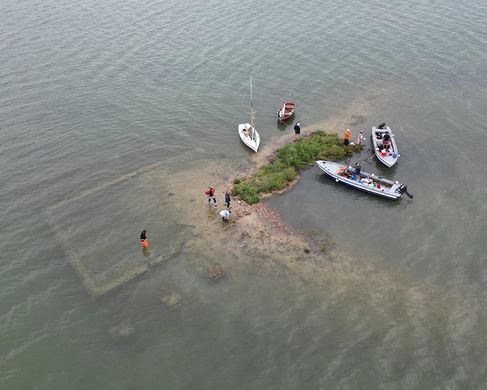
2023–ongoing, Laboratorio Laguna / PhD on Sail, Venice — An ongoing, immersive research academy navigating the Venetian lagoon as a method and site for artistic and spatial inquiry. The programme brings together international PhD candidates and faculty from Berlin University of the Arts, Kunstuniversität Linz, and Zurich University of the Arts, exploring navigation, balance, and collective engagement with wind, water, and environment. In 2025, the project appeared as part of the Austrian Pavilion public program at the Biennale of Architecture, presenting roundtable discussions and lagoon-based research to audiences, highlighting ongoing investigations and experimental practices.
2022–ongoing, Ogio, Venice — A former semi-abandoned warehouse in the heart of Venice, managed by BiennaleUrbana since 2022 as a hub for workshops, educational programs, and the PhD on Sail. The space also serves as a production workshop for artistic and craft practices and hosts artistic and research residencies. In a city like Venice—long celebrated for its heritage but often reduced to a site of cultural consumption—the project transforms a neglected building into an active site of experimentation, learning, and collaborative creation, combining urban regeneration, pedagogy, and hands-on artistic production.
2022 AltoPiano‑CommunityHub, Comune di Lavarone, Lavarone (TN), Italy Creative Living Lab workshop and participatory regeneration of the former school into a community hub through co-creation with local actors, students, and residents. The project transformed a neglected public building into a vibrant site for community engagement, artistic experimentation, and local collaboration.
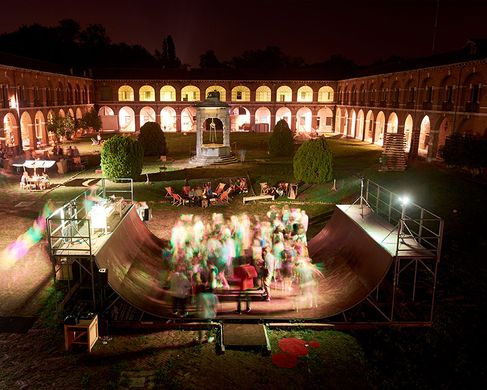
2016-2019 Esperienza Pepe, Lido di Venezia — Second Temporary Use project promoted by the Agenzia del Demanio. A long-term urban intervention and research-action project at the former Caserma Guglielmo Pepe, transforming abandoned military barracks into a site for workshops, cultural events, transdisciplinary residencies, and collaborative experimentation in urban regeneration. During the 16th Venice Architecture Biennale, the project was presented in its ongoing process at the French Pavilion Lieux Infinis, as the Italian case study within the exhibition.
Publications
Andrea Curtoni, Giulia Mazzorin. Ein veränderlicher Ort der Gemeinschaft, in: Muhamed Beganović, Clemens Stachel, Rückschau auf das Festival für Gegenwartskultur, Tangente 2024, Ein Blick zurück. Wien: Qamar Verlags GmbH, 2024.
Andrea Curtoni. Beyond the perimeter. The (new) Venice biennale and rethink the city, in: AKT & Hermann Czech, Austrian Pavillon Biennale Architettura 2023, Partecipazione/Beteiligung. Wien: Luftschaft Verlag, 2023.
Andrea Curtoni. Vuoti domestici nello spazio abitativo pubblico a Venezia. Una lettura del patrimonio dell’Agenzia Territoriale per l’Edilizia Residenziale di Venezia, in: Archivio di Studi Urbani e Regionali, LIII, 135, 2022.